
In Buddhist cosmology, the universe has no beginning, middle and end. Thus, there is no ranking from minor to major importance in Japanese building either, in fact it is entirely unknown in Japan, and their additive spatial development of their buildings includes no highlights. This includes the almost austere lack of furniture which we have already seen in relation to madori, since any permanent furniture would completely commit a space to its use, much like in Western residential homes, where rooms have different uses, and thus different grades of importance, like the hôtels particuliers in Paris, with their spaces ranking from the bare maid’s chamber to the magnificent ballroom.
“There is no room here for a piece of furniture […]. In this corridor – just like in the Japanese ideal house – which is free of furniture (or contains very little furniture), there is no place that describes even the slightest property: neither armchair nor bed nor table, from which the body could constitute itself as the subject (or master) of a space: there should not be a centre.” Roland Barthes, Das Reich der Zeichen
Tokonoma
“The room is bare except for a central alcove, in which, behind the altar, is a statue of Bodhi Dharma, […], or of Sakyamuni [(Buddha)] […]. The altar of the Zen chapel was the prototype of the Tokonoma, – the place of honour in a Japanese room where paintings and flowers are placed for the edification of the guests.” Kakuzo Okakura, The Book of Tea
However, there is a space in the Japanese teahouse that has a more important meaning, sometimes even a sacred one, and could be considered a spiritual centre of the house: the tokonoma, or picture niche, in which tea masters will usually hang a scroll or place a flower arrangement, a decoration which can be seen and admired in most Japanese leisure rooms. Indeed, the tokonoma is rather common, and before the Meiji restoration, every Japanese home had one. Ochaya still have tokonoma as well, and the okaasan train in flower arrangement, unlike geisha, who used to, but not anymore. The tokonoma can also become a sacred space on special occasions, like the New Year for example, the most important Japanese festivity, during which mochi sweets will be placed in the tokonoma for the gods when they visit the house.
Indeed, if the rooms remain without décor, the rooms with the tokonoma possess a place that could be decorated with a hanging scroll or a flower vase.
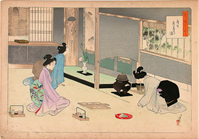
However, it did not serve exclusively as a place for the exhibition of a work of art, but since the feudal period it has also marked the most important area in the room called kamiza, from which the rest of the seating arrangement was defined. The highest guest sat with their back to the tokonoma, and this seating arrangement was modified during the tea ceremony, to allow every guest to admire the decoration objects of the day.
“With the tea master Sen no Rikyû, the wabi ideal of teahouses in grass hut style reached a climax. With a strong emphasis on the spiritual aspects of the chanoyu and a completely inward orientation, the tokonoma became the absolute centre of space. All other elements had only a subordinate function in relation to this.” Kakuzo Okakura, The Book of Tea
A formal tokonoma in the tea room is called hondoko. It should face south and receive light from its right side.
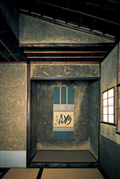
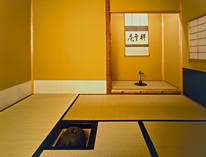
Given the absolute central importance of the tokonoma, its identity is obvious: it’s the natural knot of the trees, the all-encompassing centre of our structure. Everything relates back to that emptiness made useful. In our case however, it would not be used for display, since it already holds the entire structure, quite literally.
At the same time a functional, spiritual and aesthetic concept, both spatial organisation and constructive details assign it a special position in the structure of the house. Along with the tokonoma, the tokonoma post toko-bashira is of special importance, and implicates meticulous design.
“In Japanese architecture, the column has always had a special significance that goes beyond the symbolism common in other cultures – as a sign of power or the will to build: already on Shintoism, trees were thought of as a means for gods to descend and columns as seats of deities (kami), which led to the fact that in many shrines the columns were particularly accentuated at the gable ends. Visible from afar, they carried the ridge beam and thus the main load of the building.” Wolfgang Fehrer, The Japanese Teahouse
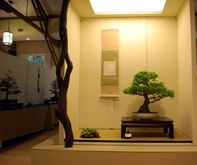
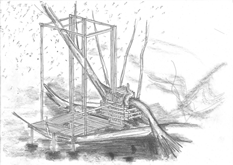
The toko-bashira differs in its nature from the rest of the construction: its wood is different, special, the trunk is mostly used with its natural curvature, and this natural form of the support disrupts the tension structure of the space that is otherwise characterized by rectangular patterns.
“In many cases the bark was left on the trunk to emphasize its natural state.” Wolfgang Fehrer, The Japanese Teahouse
This makes the identity of our toko-bashira rather obvious, once more: it’s the living tree which acts as our roof. Emerging from the hashtag, the tokonoma, it’s as natural as can be, and indeed, its gabling when reaching our supporting structure emphasises its Shinto meaning.