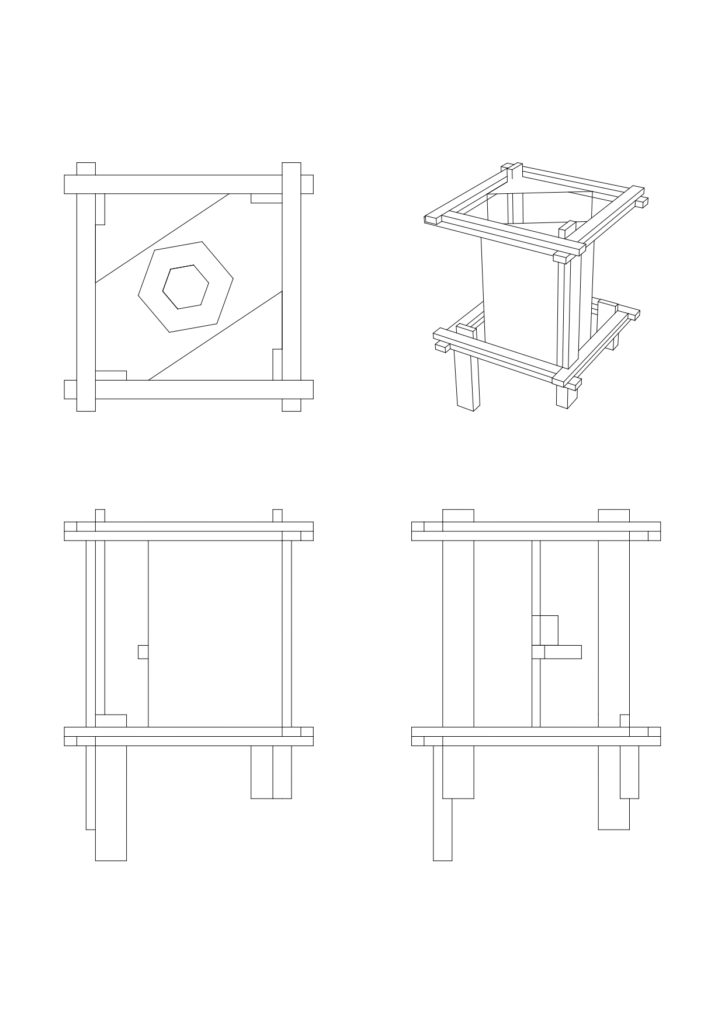
Here is our third prototype of frame to englobe our object, as it was planned after several other attempts and explorations of various forms.
An Hexagonal Frame?
As our object is an hexagonal shaped temple, we first taught of making an hexagonal frame that was thought to represent the perfect geometry of it. But we realized it was a risky choice because we would basically end up making another decorative object just to look at and that would really add a value to the site.
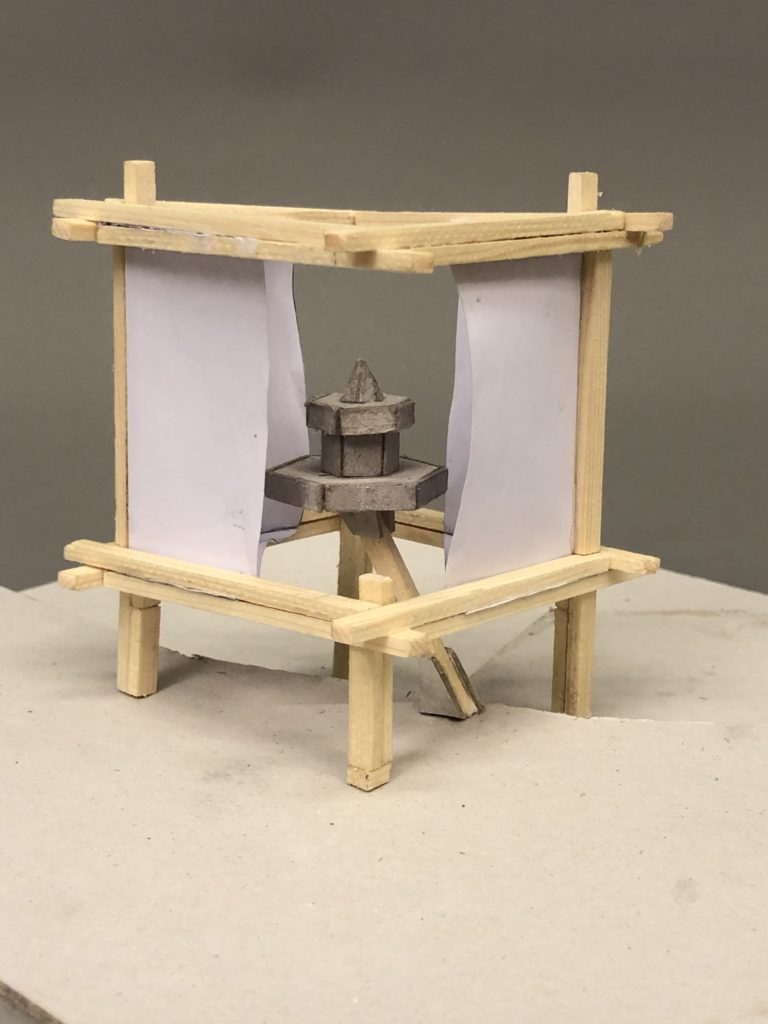
Why not basically a Cube ?
After realizing that an hexagonal frame would just mimic our object with our really adding anything, wee thought about challenging the perfect geometry of it, just as we did with the drawings and to question our visual interaction with it. We decided to orientate the observer’s vision using a pretty simple form.
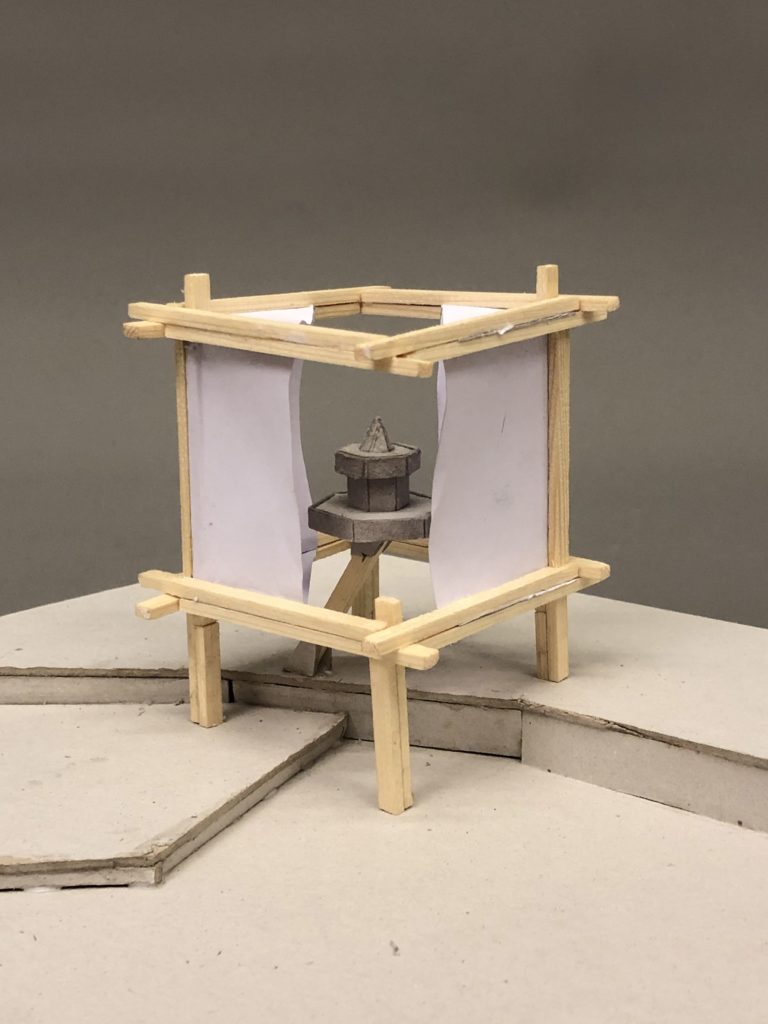
How to orientate the vision ?
As the object is very geometric, we usually look at it from a certain face and the vision of it don’t really change depending of what angle we choose, as it has twelve symmetrical axis. Our choice was to hide some faces of the temple by adding some blinding parts to our frame, letting just a narrow slice open, facing an angle of the cube.
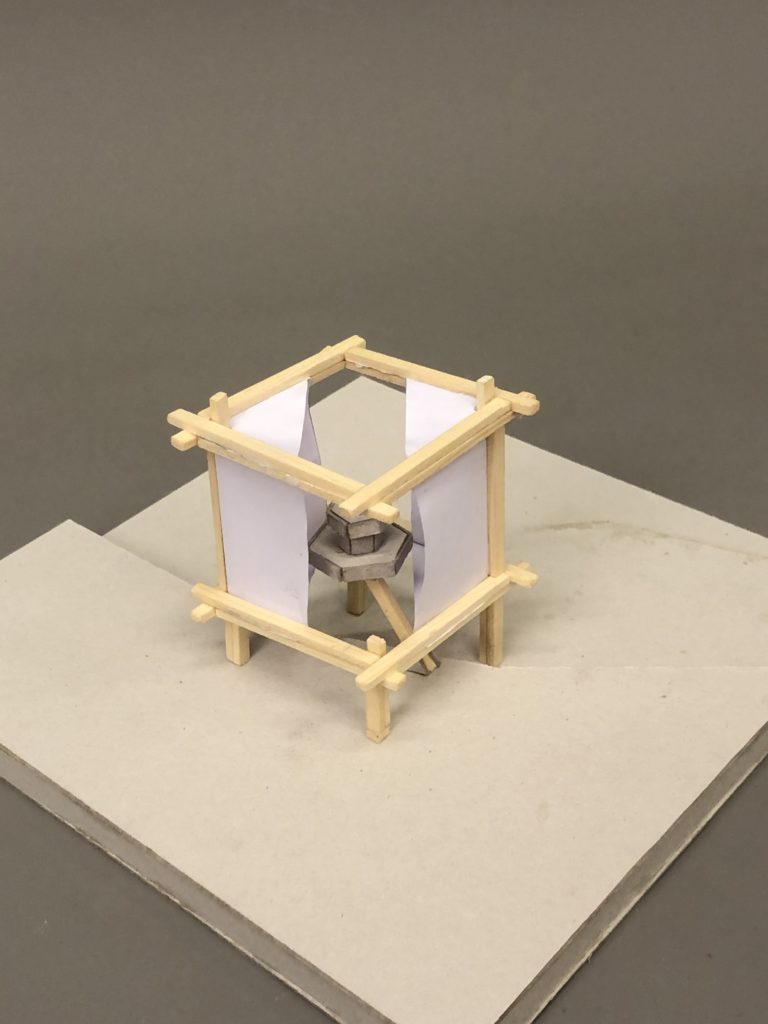
Oriented in what direction ?
As our object is located near a path, most of people seeing it observe the object from a certain angle that faces this path. Our choice in the orientation of the mock-up was to hide the object from the main path, to make the action of looking at it a more active action than requires to actually walk a bit around to find the open angles from the water pound or the little bridge.

Technical Choices
The realization of this prototype made us ask ourselves several questions about how to build it or how to make the blinding parts. We decided to use a light black coton fabric, that wouldn’t attract too much the eye and would contrast enough with the object, instead of a white or a red option that would either fade with the object or be too eye-attractive.
A cube usually has four vertical edges the gives itself a very strong and solid structure. But as we decided to remove the two edges that were going to face our open sides. That was the main challenge of our construction process, as the fabric needed to be stretched perfectly in the studio on each half, on some not so stable strcutures.
Our last challenge was to integrate our construction to a site about which we weren’t so sure about the topography. We decided to make to longer adjustable support that would adapt to the actual topography.